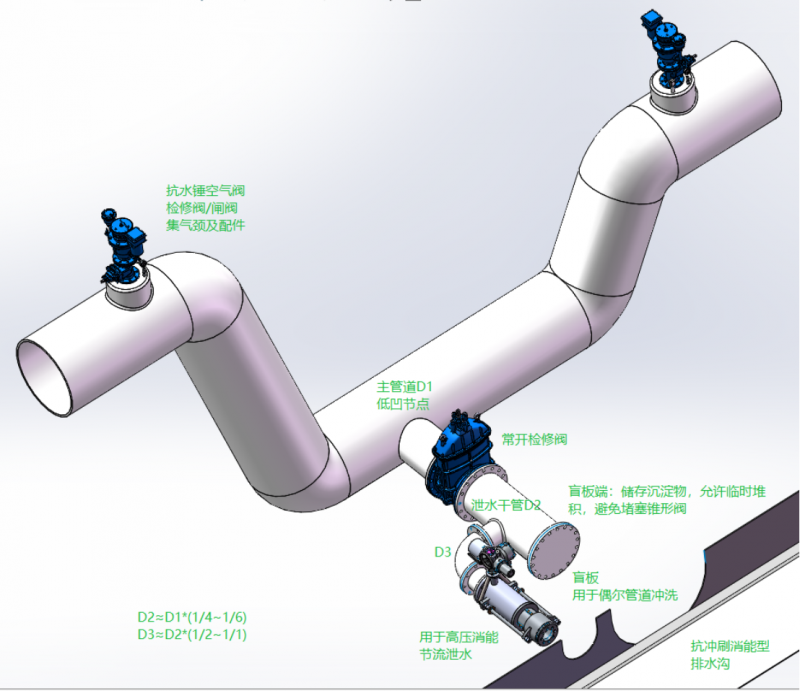


The Challenge: High-Pressure Constraints at Pipeline Low PointsLow-lying nodes in water transmission pipelines typically experience high steady-state pressure, often reaching the maximum values of the entire network. During drainage and blowout operations, gate valves or semi-ball valves (sized around 1/4*D) face massive discharge flows under steady or static pressures of 60–100m, or even 150–200m. Under such extreme conditions, flow throttling becomes exceptionally difficult or entirely impossible, posing severe risks to equipment safety.
Our Solution: Redstar's Proprietary Drainage & Sand-Flushing TechnologyAnhui Redstar Valve Co., Ltd. resolves this industrial challenge through a highly scientific, structured technical approach:
Utilizing a gate valve or semi-ball valve (sized at D2 ≈ 1/4*D) as the primary sand-flushing main line and control valve;
Implementing a series-then-parallel configuration to bypass a pressure-reducing and flow-regulating valve (or blowdown valve, sized at DN3 = D2 * [1/2~1]) as the initial discharge valve under high-pressure states;
Closing the flow-regulating and control valves once pressure drops to H = 20–40m, opening the terminal blind flange, and then rapidly reopening the control valve to flush sand under safe, low-pressure conditions;
Installing anti-water hammer air valves (sized at approx. 1/6*D) at the high peaks on both sides of the low-lying node; and
Deploying 2 to 4 surge anticipation valves (sized at DN4 ≈ [1/2~1/3]*D2) on both sides of the drainage main line, configured with staged set-pressure intervals to guarantee complete system protection.